|
=======================================
Weekly Strokes' Handwriting Analysis Newsletter
Your Highest Life Values.
=======================================
As the legendary Gandhi stepped aboard a train one day,
one of his shoes slipped off and landed on the track.
He was unable to retrieve it as the train was moving.
To the amazement of his companions, Gandhi calmly took
off his other shoe and threw it back along the track to
land close to the first one. Asked by a fellow passenger
why he did so, Gandhi smiled, "The poor man who finds
the shoes lying on the track will now have a pair he can use."
=======================================
TABLE OF CONTENTS
=======================================
1. F.A.Q: I'm not happy.
2. FEATURE STORY: Book Excerpt: Your Highest Life Values.
Six Questions that could change the direction of your life.
(Print these out. Take 20 minutes for yourself.)
3. SPOTLIGHTED LEARNING TOOL: Success Secrets book
4. UPCOMING EVENTS: Meet us in Chicago - tell your friends!
=======================================
F.A.Q.
=======================================
QUESTION:
I'm not happy in life lately and I don't know why?
ANSWER: Big question. First you have to investigate
clinical depression (see chapter 20 of the Rich & Happy
book), which can cause the brain to "feel unhappy" even
if your life is going well. If you are keeping healthy
and the seratonin levels in your brain are normal... it
is a bigger issue.
The most common life issue among adults is the separation
between someone's highest values and their current daily
duties. If you do the excercises in today's article and
really do some soul searching about what makes you
happy...you then have to find daily duties that align with
your highest values. Note: be careful to be HONEST with
yourself. If you like adventure more than you like
Bible study but should like Bible study more...get more
adventure. Life is too short to live in what we "should do."
=======================================
FEATURE STORY:
What do you Value Most? Happiness Test
=======================================
Dear Friend,
I've noticed a shift in awareness is so many of my friends
over the past year. In fact, not only are many losing their
jobs...many are simply choosing a more fulfilling path. At
some point as we become adults, we get very clear on
"what we don't want." i.e., "I won't tolerate a man who hits
me, a woman who cheats, or a boss who is rude." However,
unless you take the time to really discover your innermost
values, you often move in a direction that is ultimately less
than true fulfillment.
One of my favorite quotes alludes to most people's largest
obstacle in achieving what they want in life. It goes
something like this:
"I finally reached the top of the ladder only to realize the
ladder was leaning against the wrong wall."
Take a moment this week to find a quiet place with a pen
and paper and answer these six questions. Write down
the answers...it's very therapeutic to write. (And, since you
will be writing anyway, remember to cross your t-bar at
the top of the stem.)
These questions were originally created from the field of
personal coaching. They are firmly grounded in the
principles of a good life-coach - digging into your soul
and finding out what is really meaningful to you, then
living those principles. If you want a "map" to living these,
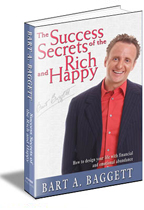
read my latest book "The Success Secrets of the Rich &
Happy"...now available in paperback and PDF file from
our home office.
http://myhandwriting.com/ssrhhtml
*** The 6 Magical Life Questions ***
You are the only person who will ever read these answers.
Write out your answers in handwriting. Use as much space
as you'd like.
#1. What are your basic needs in life?
What has to happen for you to get those needs met, so
you can be free to focus on what you really want?
#2. What emotions are MOST important to you?
Answer this question with as many words as you can
think of:
What is important to you about life?
Out of that list, what emotion does each of those words
elicit?
Now, finally and most importantly...rank those emotional
states in order of absolute priority. (Do this based on
REALITY, not on what you "should" find important.)
E.g., If you watch TV five nights a week and don't exercise,
clearly "relaxation" is a much higher emotional value than
"health."
After all that...make a short list of this information:
What are your highest three values in life?
Number them in priority 1, 2, 3.
What are your highest values in a relationship?
Number them in priority 1, 2, 3. Example: trust, fun,
passion
Now, is your current career and primary relationship
fulfilling these essential and primary emotional values
for you on a daily basis? If not, you can now see why
you are feeling distracted and unfulfilled.
#3. Can you say NO to things you don't want to do?
What boundaries have you allowed people to cross out
of a desire to be "nice" or "kind" or "tolerant?" To what
are you are going to say "no thank you?
This is the only way you can win your time back from
"time vampires."
#4. Can you say YES to things or people who reflect
your priorities? To what or to whom are you going to say
"yes, I want to?"
Spend your time ONLY with the people who fulfill your
highest values.
#5. Eliminate your top energy drainers and time
vampires - the who and the what. Make a list of the
top energy drainers (including people) in your life.
Use his or her full name! List them here.
(Examples: TV, soap operas, Aunt Bessie Jones,
John Williams at work, etc.)
What are you going to do to eliminate them from your
world (or at least decrease their influence)?
#6. Take good care of yourself - take time just for you.
Choose three activities that are just for you.
(Examples: movie, meditation, walk in the park.) Now
pick a time to make this "you time" a part of your weekly
schedule. Yes, schedule it. This is JUST as important as
that business phone call; schedule yourself first.
************************
The concept of living in your highest values is covered in
great detail in Chapter 4 of my new book "The Success
Secrets of the Rich & Happy." In the research, I have
found that people who know which emotions have the
most importance (fun, family, love, adventure, creativity,
etc.) are most likely to make choices to live these emotions.
Below is an excerpt from Chapter 4 of the new book. This
chapter is titled: Values: The Secret To Effortless Motivation
One of the most important steps to discovering how to live
in a state of wealth and happiness is to establish how much
you value specific emotional states. By understanding how
much you value each emotion, you can then determine what
has been stopping you. You can also create an extremely
compelling mission that works with your values.
Take this simple test:
Which of these emotions do you value most? (Security,
adventure, success, peace, fun, love, trust)
No, you do not value them all the same. One pops out as
being the most rewarding. And, one probably stands out
as being the least important. Take a moment and rank
them in order of your preference. #1 being the most desired
emotion and #7 being the least important emotion to feel.
The above seven words are actually just labels to describe
an emotional experience. Whether that label is #1 or #7 is
really the amount of value you have assigned to this emotional
experience. Your brain has already assigned a VALUE to
almost every possible experience. The problem is, you don't
know what value it has assigned. In many cases it assigned
a value to some experience when you were seven years old.
Today, your brain still perceives that emotion as a #1 value,
when in fact you want it to be #7.
For instance, when I was a kid, my parents got divorced.
At the time, I associated marriage with emotional pain.
Although my mom's second marriage has been 20 years
of love and bliss, whenever I got into serious relationships,
my brain still remembered the pain of the divorce. So, even
though I wanted love, I spent my twenties valuing freedom
over marriage.
Most people have conflicting values that make them feel
stuck, or pull them in two different directions: security vs.
adventure, love vs. freedom.
The seven-word test above was a simple learning tool.
There are probably hundreds of words you can think
of that describe your emotional states. Let's explore
which of your values move you toward pleasure.
I encourage you to take a few minutes and really answer
the following questions as completely as possible. First,
answer them in your own words. If you get stuck, I have
provided a list of common values a few pages away. Use
your own words. They contain more emotional juice than
words you choose from a list. You can choose values
that pertain to your whole life. Or you can be more
specific and elicit your values about being in a relationship.
If you are really serious about making all areas of your life
work, I suggest answering the question five times - once
for each category; Life, Career, Relationship, Health and
Family.
How to Elicit Your 'Moving Toward' Values
What has been most important to you in life?
Or, another way to phrase this question:
What's most important to me in ___________?
(Life, Career, Relationship, Health, Family, etc)
What else is most important to me in ___________?
(Same categories as above)
Now, this question will guide you to rank the value of
each emotion from highest to lowest.
What has been most important to you ,
_____________ or _____________?
In order to get the proper values, you must be careful
to choose the actual "ends value" and not the "means
value." I'll explain. Have you ever heard the Machiavellian
phrase that says, "The ends justifies the means"?
Essentially, words like money, family, relationship are
means to experience specific emotions. The emotions
are the ends values. For example, having money gets
me the emotion of freedom, security, and peace of mind.
Having family gets me the emotions of love, passion,
and contribution.
Some Common 'Moving Toward' Values
(Feel free to add your own in the blank spaces provided)
Achieving Adventure Career
Comfort Contribution Creativity
Freedom Friendship Fun
Happiness Investment Making money
Health Helping others Honesty
Intimacy Knowledge Love
Learning Growing Making a difference
Passion Power Respect
Security Spirituality Strength/vitality
Success Wealth
______________ ______________ ______________
______________ ______________ ______________
______________ ______________ ______________
______________ ______________ ______________
Do not read on until you have elicited your major values
for the above questions.
The above two questions elicited values that you are
drawn toward. These tend to be positive emotions that
you want more of in your life. Remember the test I did
with the $100 bill and lighter? Which one was a more
quick and compelling motivator...the flame or the cash?
(Pain or pleasure?) That's right. Pain tends to get our
attention quicker. And most people will work harder
to avoid pain than to gain pleasure. How urgent do
you get to earn $200? Is the motivation more when
you want to buy a new dress or when you have an
eviction notice stapled to your door?
Many people live in a state of drama and urgency
because pain is the only motivational strategy that
gets them to take action. Therefore, it is equally
important to know what emotional states your brain
is currently programmed to avoid at all costs. What
we want most and also what we fear most shapes our
lives.
Example: if you really want success, but you are
programmed to avoid the pain of rejection, you
will have trouble succeeding in a sales job. People
struggle with value conflicts all the time and don't
know why they feel torn or stuck.
How To Elicit Your "Moving Away From" Values
So take a moment to answer this question. The
resulting list will be your primary "moving away
from" values.
What have been the feelings or emotions you would
do almost anything to avoid having to feel?
Once you have your list, rank them in order.
Would you do more to avoid feeling _________
or __________?
(Which would you do more to avoid having to feel?)
Keep asking the above question until you have ranked
them in order of highest rank to lowest rank.
Here are some common moving away from values:
Frustration, anger, depression, humiliation,
embarrassment and physical pain.
What Did You Learn?
Now, look at both of your lists in ranking order. Do
you see any conflicts? Ideally, your moving away
from values will push you toward your goals, and
your moving toward values will pull you toward
your goals.
If you know a person's value, you can predict a
person's direction in life. Your values are like the
walls of a pinball machine. They bounce you from
one direction to another. Some 'push' you in a
direction and others 'suck' you in another direction.
If all your values are 'pushing' you back and forth,
you might begin to feel like a pinball. Moving very
fast, but not getting very far.
Just as your goals can change, so can your values.
If values are merely the ranking you give to the value
of the emotional experience, your values will change
with your level of experience. Don't despair if you
find a value conflict. Just be grateful it has come to
your attention, and you can begin to change yourself,
so that success will come easier than before.
Example #1:
If you are a 21-year old virgin, the desire for "sexual
stimulation" might be ranked #1. But, after that same
person has been married for 20 years, the value of
"sexual stimulation" might rank lower on the value
scale than love, connection, commitment, etc. We
tend to change our value of something given the
rarity or the abundance of that experience.
Example #2 Bob and Nancy:
I once knew a guy named Bob. Bob had a self-confessed
fear of commitment. His girlfriend, Nancy, was getting
impatient with his resistance to getting married. Upon
eliciting Bob's values, it was clear why Bob had such a
difficult time making the long-term pledge of his love.
Bob's #1 Toward value was freedom.
Bob's #2 Toward value was love.
Bob's #1 Moving away from value was loneliness.
Bob's #2 Moving away from value was being controlled.
You can imagine the inner struggles Bob was having. Bob
desperately wanted to avoid feeling the emotion of loneliness
but was ranking freedom as the #1 positive value he thought
he needed to feel in order to be happy. Once this ranking
came to his awareness, he was able to work through why he
felt being married was a sacrifice to his freedom. When he
realized that in order to keep his version of freedom he must
sacrifice his love and feel lonely, he felt pulled in two different
directions.
From his past both freedom and love had been very deep
and important, and he associated pleasure with it. So,with
his new awareness of his values, Bob began to re-assess
his rules about having freedom. When he began looking,
he found the evidence.
Bob had unconsciously adopted a rule that marriage = no
freedom. Hmm. Bad rule for Nancy. She had a belief that
marriage = freedom (freedom to express, to be authentic,
to be vulnerable, etc.) Bob began to look for married
people who experience freedom and asked them how
they did that. He began to look for evidence to dislodge
his limiting beliefs regarding marriage and freedom.
So, both people wanted love and freedom. But, they had
different rules about how to achieve these states. Bob
eventually decided that love was a more compelling and
rewarding emotion than this old version of freedom. Then,
he and Nancy discussed all the ways he could feel free
within a committed relationship. Once Nancy agreed to
those rules, Bob felt comfortable moving forward with the
engagement.
Example #3: 40-year-old man
Here is an example of the values chart of a 40-year-old
man who wants to be more financially successful. The
first chart is how his values appeared to him after taking
the above quiz. The second chart is how we 'designed'
them from out of his own power of choice. I have included
only the top six values. Your chart may include 10 - 15
values.
Old Value Ranking:
Toward Pleasure Values Away From Pain Values
Love Failing
Fun Loneliness
Freedom Being Controlled
Security Physical Pain
Adventure Risk
Success Being Bored
What changes would you suggest?
New Value Ranking
For example, here are the newly designed values
from this 40-year-old:
Toward Pleasure Values Away From Pain Values
Love Being Bored
Success Physical Pain
Fun Loneliness
Adventure Being controlled
Freedom Risk
Security Failing
For this demonstration only, I re-arranged all six values.
In your life, you don't have to keep any values you don't
want to. In the above example, I would most likely suggest
he put fear of failing at the very bottom of his list of twelve
moving away from values and put new values such as 'being
mediocre' or 'feeling broke' near the top of his moving
away from values.
Do you think he will find achieving success much easier
now than before? Notice how his life will change.
First, I didn't suggest he re-arrange his #1 life value of
"love." His wife might not appreciate that. So, he kept
Love as #1, but we moved "loneliness" from #2 down
to #3 moving away. This slight change will make it
okay to spend more time working and less time with
his wife in order to be successful. (If that is okay with
her.)
Second, we moved "fun and freedom" down on the list
so "success" could rank higher. He obviously had a habit
of choosing the short-term "fun" instead of working toward
a long-term success. Fun is still in the top three, but now
he has balance.
Third, we moved "freedom" down to #5 so he has the choice
to work for a company that pays him big money, if he so
chooses. For many people that have 'freedom' so high on
the scale, they avoid any type of career or opportunity that
compromises their freedom. He might choose to work a
high paying corporate job for three years and earn four
times the salary. He now has that option.
Fourth, we moved "security" down to the bottom of the
Moving Toward list. This would be a difficult transition
if it was #1, but since it was #3...it could be accomplished.
Now, the concept of "security" is less attractive and he is
free to take more risk.
Fifth, we adjusted the moving away from values so he
isn't so fearful of risk or failure. This isn't the ideal value
structure. It is just an example. I was tempted to include
the value structures of self-made millionaires and other
successful and/or happy people. But, out of respect for
your individual mission, I will not do so. You might be
tempted to "program" their values with the assumption
that will make you happy.
Nope.
You have to choose your own value chain based on your
own desired outcomes. I will give you hints throughout the
book to which #1 or #2 values tend to make people the
most happy. I will relay this piece of advice that I learned
from Dr. Tad James many years ago when I was struggling
financially.
Tad assisted us in eliciting the values of the participants in
the workshop. He specifically asked us what was important
in a career. Therefore, we were eliciting the emotions that
made us most satisfied in a working environment. He then
asked people to raise their hands if they ranked the value
of "making money" or a similar phrase in the top three
career values? As we looked around the room, only a
few raised their hands. He said, "In my experience talking
to thousands of people, the people that have 'making
money' in the top three values always do well financially."
And, it makes sense. If you value freedom, teamwork,
or fun more than making money...you will consistently
choose those values before you grab the cash. You don't
have to make it #1, but if you want to earn money, then
put that value at #1, #2, or #3. Why? Because you make
decisions based on what you value most.
When you put making money that high in your value chain,
you begin to sort opportunities with "cash flow" as a priority
and not as a hope. You will choose which business people
to spend time with based on your financial best interest. If
you are serious about making money in your career -
consider moving around some values to make your work
pay off.
How to Change Your Values:
Changing your values can be as complicated or as easy
as you make it. The awareness of where your values are
today is the first step to effectively changing them. On a
daily basis, being aware of the decisions you make is a
good place to practice living within your chosen value
structure.
Now, I will share with you an easy and effective way to
move values higher on your list.
For this demonstration, let's use Money as the value
you would like to move higher on your list. Many people
see money as merely a means-value. They feel money is
merely the means (the path) to a more important value
found in the end. That's okay. They don't particularly
get much emotional satisfaction in earning money. They
do it to get the other values.
Other people experience a strong positive emotional
charge when they earn money. These people feel money
is an ends-value. Because of this emotional charge attached
to money, they often have an easier time earning money.
If you want to experience a more positive emotional charge
to money, all you have to do is associate the same positive
emotions of your top three values with the act of making
money. This mental conditioning will train your brain to
feel the same good feeling when you earn money as you
get from your other top values.
Essentially, this process changes the way you value money.
When you place a high value on money, you begin to
naturally attract money.
All you have to do is begin seeing "money" using the same
mental processes as you are currently seeing your #1 value.
You do this by eliciting your submodalities. Submo-what-ities? ...
[end of excerpt. Continued in the book]
http://berichandhappy.com
=======================================
SPOTLIGHTED LEARNING TOOL: THE BOOK
=======================================
In the book, I explain how to change your current values
and belief systems so that your unconscious will assist you
in moving in the direction you really want...not moving in
the direction of the programming you had when you were
eight years old. You will love all 23 chapters.
The book is now available in hard copy (for U.S.
customers only) and PDF form.
About Bart Baggett's latest book:
Do you have The Success Secrets of the Rich and
Happy yet?
"Great Book. Intense, rich, profound, entertaining...
A book I would have liked to have read when I was 18."
- Cristiano Sileim Florence, Itali Ducati.com
"I have read many self-help books. Bart's is one of the
easiest to read. He has a very fluid style that complements
his ideas and conveys them in an easy-to-understand way.
"The handwriting analysis section was of particular
interest as I am able to know a person on the first
meeting better than many of their close friends. It also
helps to see where people are coming from while not
being so rash in my initial judgments (which are often
misinformed). I would just like to thank Bart from the
bottom of my heart for sharing some of his many gifts.
Thank you for all you've done to help me and others
so far. I know it's a river of abundance that will
continue to flow.
"This is a book you'll want to read over and over again.
Guaranteed."
-Randy W. Hall, Detroit, Michigan, USA
http://berichandhappy.com
=======================================
UPCOMING EVENTS
=======================================

Meet us in Chicago for the next 1-Day Intensive
on Saturday, April 16th. Discount tickets are still
available - but going fast! C.l.i.c.k. here for more
info:
http://www.myhandwriting.com/seminars
=======================================
CONTACT US TO LEARN MORE�
=======================================
Bart Baggett, Author and Lead Trainer
Maryann Redhead, Director
HandwritingUniversity.com
1-800-398-2278
[email protected]
https://www.handwritinguniversity.com
-- |


